
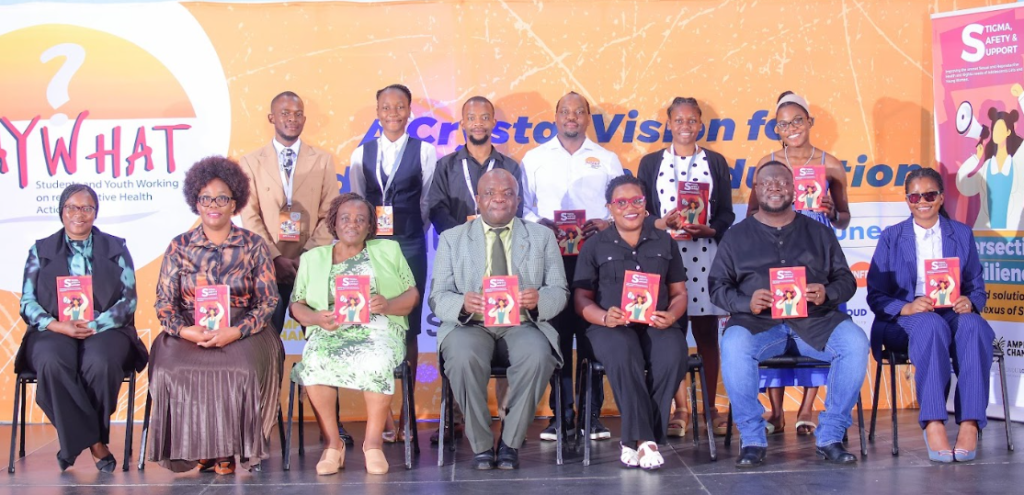
15th SAYWHAT Students Conference Introduces Parliament Researchers
By Kuda Pembere
The 15th edition of the Students and Youth Working on Reproductive Health Action Team (SAYWHAT) Students Conference roared to life on Monday with new additions, namely the presence of Parliament researchers and students from universities, teacher training colleges, and agricultural training institutions.
The opening day featured a Research Indaba where parliamentary portfolio committee researchers shared insights and educated students on how Parliament works. Research papers presented by students covered topics such as GBV among males, the nexus between Sexual Reproductive Health and Rights (SRHR), disability and climate, the uptake of SRHR information on social media, as well as the infringement of female students’ SRHR.
Speaking to HealthTimes, SAYWHAT Executive Director Jimmy Wilford said this year’s theme was titled “A Crystal Vision for Student Health and Education.”
“Today’s conference marks the 15th edition of the National Students’ Conference that has been organized by SAYWHAT since 2006. So, 15 years we are looking at crystal vision, you know, we are not looking at the crystals just like in general life, we are looking at crystal vision for sexual reproductive health and education, for health and education for the students,” he said. “So, the whole idea is we want to unpack the diversity of challenges and innovation that has been coming up over the years in regard to addressing sexual and reproductive health challenges for young people in general and the students in particular.”
He highlighted the importance of students engaging directly with Parliament researchers.
“And we convened the National Students’ Conference for multi purposes. Firstly, it is a platform where students come together with the policymakers, college authorities, policymakers who include parliamentarians and other stakeholders so that they can listen to the voices of students. Students also listening to other stakeholders, sharing information, exchanging ideas on how best to address the challenges that we are faced with,” he said. “You know, when you are looking at the Parliament, the Parliament is meant to come up with laws, and what we are doing here is to influence or to advocate for the inclusion of certain aspects that affect or impact positively on young people. So bringing parliamentary researchers, parliamentary researchers are the drive behind the Parliament work, so having them on board and having them listening to the young people, it will also aid in how they are going to come up with policies or to influence policies at the Parliament level that can have a positive impact.”
Wilford added that it was time for the conference to produce actionable policy proposals.
“Because right now young people are coming up with various issues or proposals in terms of the discussion that they are having. If we cannot engage with the policymakers, otherwise this conversation or the conference can just become a talk show,” he said. “So we realise that it is important now to ensure that parliamentarians are important, but parliament researchers are more important because they are the drive behind the parliamentarians.”
He also noted that SAYWHAT is working to address the impact of social media on the uptake of SRHR information.
“We are using various ways of making our edition or putting our voice on social media. Firstly, we train the young people to know that they cannot believe everything that they read on social media. Social media algorithms, sometimes how they are made, sometimes they can be made in a way that is meant for somebody to ensure that there is a lot of reactions, a lot of engagements with the monetization that has come across,” Wilford said.
He added, “People are getting more money when they are sensationalizing issues, even putting out the incorrect information can attract a lot of traffic on your page, which again can even misinform the community. So we are encouraging young people, we make use of this platform, the National Students Conference, to educate the young people that they cannot believe everything that they see on social media. They need also to read in between the lines and verify every information that they come across.”
SAYWHAT advocacy specialist Isabella Michael said future programming will include activities that address social media misinformation.
“I would like to emphasise that as SAYWHAT we recognise the findings that came out of the student researches, specifically the role of social media and how it has been impacting the health and education of young people. And considering these research findings at SAYWHAT, we are committing to investing in digital health in our programming, in our interventions, as the next chapter of SAYWHAT beyond this crystal jubilee that we are celebrating,” she said. “Digital health is something that is cross cutting in health issues, in education issues, as well as child protection issues. We cannot ignore social media. Technology is a good thing in our lives, but we need to ensure that it is also not harmful, and this is something that SAYWHAT will continue to invest in going forward.”
She added that this year’s conference brought together students from 30 tertiary institutions.
“At this 15th edition of the National Students Conference, we have over 30 tertiary institutions that are represented in this room today, and these students are coming from universities, teacher training colleges and agricultural colleges from across all the 10 provinces in Zimbabwe,” Michael said.
Students who attended the event welcomed the involvement of Parliament researchers.
“This is the first day, and it is very important that we have all the stakeholders involved, because when you talk of the students and the young people, we cannot talk of the students without actually talking about the institutions they are coming from, all the organizations they are coming from,” Benhilda Mugwanyu from University of Zimbabwe said. “I think I saw the most important stakeholders that are here, the people from Parliament, the researchers from the Parliament of Zimbabwe, because they are the ones who know how policies are formulated, and when we have our researchers, like we have young researchers presenting on their different findings, whenever they present, those people are the ones that will receive those findings, and they know how policies are going to be formulated. So it is such a good experience that we have all the stakeholders present here today because it shows we are going somewhere.”
Dr Macdonald Lewanika, giving his keynote commended the students for coming up with researches that can shape national policies.
“The research findings that were presented by students today showed the correlation between digital spaces, mental health, drug and substance abuse, climate change and gender-based violence. These stories, these studies dismantle stigma. They also hopefully inform the law and drive innovation.
“I commend the young people who were brave enough to conduct this work, for taking space and ensuring solutions to the complexities of our time that are not parachuted from above, but grown from lived realities and coming from below,” he said.
Some of the parliament researchers said the researches had brilliant findings which they could take up into producing policy briefs for Parliament.

Leave a Reply