
Our Journey So Far
Our Journey So far
SAYWHAT was born as a membership-based organization with the express ambition to contribute to the existence of healthy and empowered young people in Zimbabwe who thoroughly enjoy their Sexual and Reproductive Health Rights (SRHR). The movement work is still led by students’ structures in tertiary institutions and young people trained and supported as community cadres. To date, SAYWHAT’s presence span across 50 tertiary institutions in Zimbabwe, with 14 established resource centers and convenes the Forum of College Authorities on Students SRH (FOCASS) which institutionalizes dialogue and collaboration with college and university authorities, strengthening the implementation of student-led initiatives.
SAYWHAT convened its first National Students Conference in Zimbabwe and Annual General Meeting resulting in the election of the first cohort of the SAYWHAT National Coordinating Committee which is part of SAYWHAT’s Governance Structures. To date, SAYWHAT maintains this tradition a new cohort of the National Coordinating Committee is elected at every Annual General Meeting held during the National Students Conference.
TAs the movement pursued its mission through demand generation, student-friendly SRH information, and gender-sensitive programming, SAYWHAT established the Web for Life Network a safe space for girls and young women to actively advance the recognition, protection, and fulfilment of women’s rights in a particular their sexual and reproductive health and rights. Girls and Young Women first advocacy win was the contribution to the 3D – Dignity Delayed, Dignity Denied Campaign which saw the Government of Zimbabwe pledge support for tax removal on sanitary wear elevating menstrual health and equity in Zimbabwe.
The Mugota/Ixhiba Young Men’s Forum was established harnessing the labelling of young men’s bedroom/ hut – gota/Ixhiba where young men could literally discuss their dreams and how they envision themselves exercising masculinity and responsibility in life. The forum engages men and boys as allies in the fight for gender equality whilst addressing their unique challenges.
Drawing inspiration from the National Students Conference, the Southern African Regional Students and Youth Conference (SARSYC), premiered as youth-led platform focused on empowering young people to shape SRHR priorities within the broader regional health policies. SARSYC quickly evolved into a regional movement, expanding its footprint beyond Zimbabwe and addressing pressing and emerging challenges faced by Southern African Youth. Read more about SARSYC on http://www.sarsyc.org
SAYWHAT began programming with social workers and psychologists to ensure every child is free from harm regardless of gender, race, disability health, geography, nationality or any other forms of discrimination. This Child protection unit has developed a Reintegration Framework that provides guidelines on the reintegration of children in conflict with the law into society.
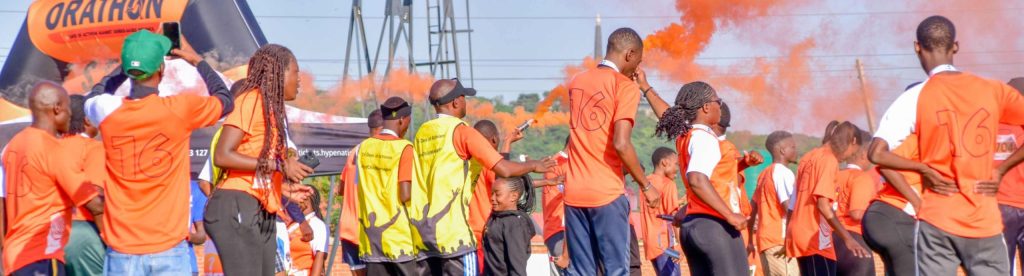
We introduced a symbolic run against Gender-Based Violence, positioning young people and communities at the forefront of efforts to end GBV while championing physical activity as a powerful tool to prevent non-communicable diseases such as diabetes, hypertension, and heart disease. Titled Orathon, this dynamic advocacy event is inspired by the global color of hope “Orange” and the endurance of a “marathon”. It features two symbolic race categories – a separate 8km routes for men and women presenting individual journeys in confronting GBV and a 16km route culminating in a united final stretch to signify shared responsibility.
SAYWHAT launched its tele-health service with the toll-free 577 as a safe space for young people to access accurate information, counselling and support in relation to GBV, SRHR issues including contraception and PAC services among others. Operating 24/7 the SAYWHAT Call Centre partners with Department of Social Development, ZRP Victim Friendly Unit, and over 50 Clinical and non-clinical service providers bring young people a confidential pathway to report any violence/ abuse.
Born out of SARSYC commitment to drive real change in the Southern African region, the Girls Education Advocacy in the Region (GEAR) Alliance emerged as a regional initiative to implement intercountry advocacy programs focused on girls’ education and broader intersecting health rights. Since GEAR inception, civil society organizations from Angola, Malawi, Mozambique, Zambia and Zimbabwe have joined the alliance actively engaging in education and health transnational advocacy.
——————
SAYWHAT launched the Studio of Choice, a home of art and creativity that allows students and young people to advance their health and education rights through audio and visual content productions. To date, the Studio of Choice have produced digital Condomize! Campaigns, National Universities Quiz and Debate Challenges, Podcast and talk shows, short films and soundtracks, reaching millions of young people across Southern Africa. Young people’s efforts are also amplified through the Creative Reproductive health Arts Festival for Transformation (CRAFT).
——————
Recognizing the interconnectedness of public health issues with SRHR, child protection and education, SAYWHAT officially broadened its programming to address climate change impacts, drug and substance abuse, maternal health challenges, mental health struggles, communicable diseases, and non-communicable diseases. This expanded scope, SAYWHAT+ formed the basis of our current strategic framework 2021 -2050 with the long-term vision to become a pan African movement with continental coverage by 2050.
—————–
We launched the Young Researchers Initiative Programme recruiting 15+ students per annum to undergo mentorship on research methodologies and conduct structured research on the health and education challenges of their time. This evidence-based approach to advocacy gives the young researchers an opportunity to present their findings as well as program or policy recommendations at the SAYWHAT Research Indaba held during the National Students Conference or SARSYC.
SAYWHAT launched the Smart Learners Hub, an e-learning platform designed to equip young people with the knowledge and skills they need to navigate through their youthfulness confidently. Smart Learners Hub is designed to be a one stop youth friendly center where once can access information and training on various issues relevant to their health and education rights for free. Explore the Smart Learners Hub here:https://smartlearnershub.net/
5 years since the adoption of the 2021 -2050 Strategic framework, SAYWHAT’s began recognizing its vision for continental coverage and registered SAYWHAT Malawi, and SAYWHAT Zambia making concrete steps toward cementing our presence in the region. While we had already gone regional through SARSYC and the GEAR Alliance, these milestones signify the transition from regional engagement to establishing a truly pan African movement.
————
Although SAYWHAT had over the years, maintained a tradition of paying tribute to the most outstanding peer educators during college/ university’s graduation season; we launched the Action for Health and Education Rights Awards. This marked a significant milestone in the evolution of student advocacy reinforcing SAYWHAT’s commitment to recognizing excellence, fostering inspiration and strengthening student/youth-led structures. The Awards spotlight outstanding contributions from students, alumni, community champions, and institutional partners across Zimbabwe who have demonstrated exceptional leadership in health and advocacy.
————-
We launched Digital Health as our fourth enabling/ accelerating pillar, reinforcing our commitment to innovate youth health, education, and child protection. While SAYWHAT has already leveraged digital platforms such as the SAYWHAT Call Centre, the Studio of Choice, and the Smart Learners Hub, this milestone enables us to scale impact, reach marginalized youth, and nurture generations of digitally literate health and education advocates.
